
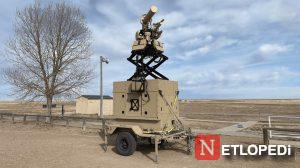
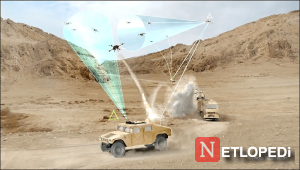
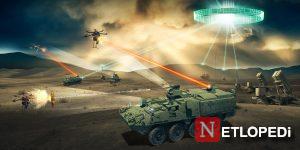

C-UAS is the abbreviation for “Counter-Unmanned Aircraft Systems” and refers to all technologies, tactics and procedures used to detect, track, identify and neutralize threats coming from unmanned aircraft (UAS / drones). In simple terms, C-UAS is the entire “defense ecosystem” against drones.
As drones have rapidly spread in hobby, commercial and military use, new security gaps have emerged for airports, power plants, stadiums, critical infrastructure and battlefields. C-UAS solutions combine sensors, software and both soft-kill and hard-kill methods to manage this new threat domain.
WHAT DOES C-UAS COVER?
C-UAS is not just a single device; it usually describes a complete chain of integrated solutions. The chain typically includes:
- Detection: Is there a drone in the air, where is it and how fast is it moving?
- Tracking: How do the position, altitude and heading of the target change over time?
- Identification: Is this platform friendly, civilian, authorized or a potential threat?
- Assessment: What is the risk level and what type of response is appropriate?
- Mitigation: Should the drone be brought down, forced back, taken over or simply monitored?
In many official definitions, C-UAS is treated as a “solution set” that includes sensors, effectors, the personnel who operate them and the legal/operational procedures they must follow.
C-UAS DETECTION TECHNOLOGIES
Modern C-UAS systems generally rely on multiple sensors instead of a single technology. Common detection components include:
- Radar systems: attempt to detect small, low-flying targets and provide range and speed data
- RF (radio frequency) detection: listens for signals between the drone and ground control to locate both the drone and the pilot
- Electro-optical / infrared (EO/IR) cameras: confirm the target visually and via heat signature and help classify its type
- Acoustic sensors: use sound from motors and propellers to detect especially small drones at short range
- Sensor fusion software: merges radar, RF, camera and acoustic data into a single tactical picture and reduces false alarms
Thanks to this multi-sensor architecture, C-UAS systems can detect small drones more reliably even in complex urban environments.
SOFT-KILL AND HARD-KILL C-UAS METHODS
To neutralize threats, C-UAS platforms use two main approaches:
1) Soft-kill
Soft-kill methods disable the drone without physically destroying it by disrupting its systems. For example:
- RF / GPS jamming: disturbing control and navigation signals to cause loss of control
- Spoofing / hijacking: deceiving the navigation or control system and redirecting the drone to a safe zone
- Link interruption: cutting the control channel between pilot and drone to trigger “return to home” or emergency landing modes
Soft-kill is especially attractive in crowded civilian environments, because it reduces the risk of falling debris and collateral damage. It also allows many targets to be stopped without consuming expensive ammunition.
2) Hard-kill
Hard-kill methods physically destroy the drone or its payload. These can include:
- Short-range guided missiles and rockets
- 20–40 mm automatic cannons and 12.7 mm heavy machine guns
- Net guns and interceptor drones carrying capture nets
- Directed energy weapons such as lasers or high-power microwaves
Hard-kill is particularly important on the battlefield, where hostile reconnaissance and attack drones must be eliminated quickly. In cities and around airports, however, legal restrictions and the risk of collateral damage require much more caution.
DIFFERENCE BETWEEN C-UAS AND SHORAD
C-UAS is a broad concept that describes “what is being countered” (drones/UAS) and the overall solution ecosystem. SHORAD (short-range air defense) describes a specific range/altitude layer and the weapon systems used in that layer.
- SHORAD: short-range air defense weapons and platforms (missiles, guns, etc.)
- C-UAS: the entire set of sensors, software, soft-kill and hard-kill tools, rules and operators used to counter UAS/drone threats
A SHORAD system can be upgraded with C-UAS capabilities (for example by adding radar, jammers and special ammunition). In contrast, a C-UAS solution protecting a stadium might rely only on RF detection and soft-kill methods without using any guns or missiles.
MILITARY AND CIVIL USE OF C-UAS
C-UAS technology is used in both military and civilian domains:
- Military: protecting frontline units, bases and logistics hubs from enemy drones; defeating reconnaissance and kamikaze platforms; building layered defenses against drone swarms.
- Civil: preventing unauthorized or dangerous drone flights around airports, nuclear plants, stadiums, border crossings, prisons and large public events.
In the civilian domain, the use of RF jamming and hard-kill methods is heavily regulated. In many countries, only authorized state agencies can operate C-UAS systems under specific conditions.
WHY IS C-UAS SUCH A HOT TOPIC?
As drones become cheaper, more portable and easier to modify, the risks of surveillance, smuggling, sabotage, assassination and precision attacks grow. A small drone worth a few hundred dollars can challenge the security of a facility worth millions.
For this reason:
- Traditional air defense systems alone are not sufficient against small drones
- Cost-effective solutions are needed for low-cost threats
- C-UAS architectures with fast decision-making, sensor fusion and automation are being developed worldwide
In summary, C-UAS is the broader and more systematic name for “anti-drone technology”. From sensors to software, from jammers to lasers, from legal frameworks to operator training, C-UAS aims to close the security gap created by unmanned aircraft.